
|
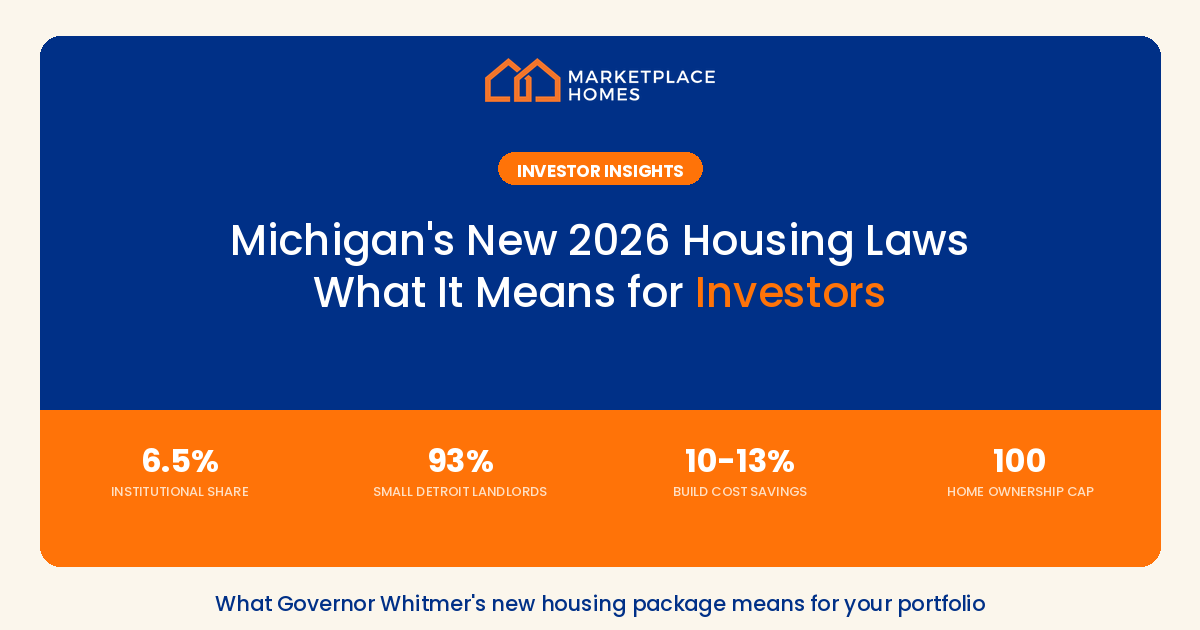
6.5%
of Michigan home purchases were made by large-scale investors in early 2025
|
93%
of Detroit landlords own two or fewer properties
|
10–13%
potential construction cost savings under single-stair reform
|
| Law | What it does | Who it affects |
|---|---|---|
| Housing Opportunity Tax Credit | New state tax credit funding ~2,500 affordable units/year | Affordable housing developers |
| Single-Stair Reform | Allows 4-story buildings with one staircase, cutting build costs 10–13% | Small multifamily builders and investors |
| Large-Scale Investor Ownership Cap | Limits ownership to 100 single-family homes per investor entity statewide | Investors with 100+ homes in Michigan |
A New Ownership Threshold for Large-Scale Investors
House Bill 6074 sets a new ownership cap in Michigan: an investor entity can’t hold more than 100 single-family homes statewide. This mirrors a similar federal proposal introduced in Congress, though Michigan’s threshold is lower.
For the vast majority of investors we work with, this is simply informational. Institutional investors made up roughly 6.5% of Michigan home purchases in early 2025, a share that’s held fairly steady rather than growing sharply the way it has in some other states. In Detroit specifically, nearly 93% of landlords own two or fewer properties, according to a 2026 study from Detroit Future City.
Even the bill’s own sponsor, state Rep. Karl Bohnak, acknowledged during committee testimony that Michigan isn’t currently seeing heavy institutional buying activity. Lawmakers describe this as a proactive threshold, put in place ahead of any growth in that kind of ownership, rather than a response to an existing issue in the state.
If you’re an individual investor or building a portfolio of 5, 15, or even 50 doors, this cap doesn’t change how you buy, hold, or manage property in Michigan. And if you work with or represent larger institutional capital, it’s simply a new number worth having on your radar as you plan acquisitions here. Either way, it’s one more data point for building or advising on a Michigan portfolio with a full picture of the landscape.
Single-Stair Reform: A Real Opportunity for Small Multifamily
This is the change I’d pay closest attention to if you’re thinking about new construction or small multifamily plays.
House Bills 5570 and 5571 update the state construction code to allow residential buildings up to 4 stories with a single staircase, up from the old 3-story limit. That sounds technical, but here’s why it matters: single-staircase buildings are cheaper and easier to build on smaller, awkward, or infill lots that couldn’t support a full double-stair design.
Industry groups are projecting this could cut construction costs by 10 to 13% on qualifying projects. For builders and investors working in this space, that’s meaningful.
Picture a small 12-unit apartment build that would have cost around $2.4 million under the old code. A 12% reduction there is roughly $288,000 back in the project’s budget, money that can go toward better finishes, a stronger contingency fund, or simply a healthier margin on the deal.
That means more feasible small apartment buildings on lots that previously didn’t pencil out, more family-sized units (which are chronically undersupplied in Michigan), and lower per-unit costs that can translate into better returns.
If you’ve been eyeing small multifamily development or a builder partnership in this space, this is the kind of regulatory change that can actually move a deal from “doesn’t work” to “works.”
The Michigan Housing Opportunity Tax Credit
House Bills 5806 and 5807, along with Senate Bill 966, create a new state-level tax credit that works alongside the federal low-income housing tax credit. Michigan joins more than 30 other states with a program like this. It’s expected to fund around 2,500 new affordable units a year, backed by up to $42 million annually in credits.
This one is primarily relevant if you’re active in affordable housing development or partnering with developers who are. It’s not going to directly affect a typical single-family rental investor’s day-to-day, but it does signal where a meaningful chunk of new state investment is headed, and it’s worth knowing about if you ever explore affordable multifamily projects or LIHTC partnerships down the road.
The Bigger Picture: Why This Matters for Michigan’s Market
Alongside these bills, the state’s FY27 budget adds $50 million to the Housing and Community Development Fund and continues to invest in downpayment assistance programs that helped over 6,000 Michiganders buy homes in 2025 alone. The state has also closed its housing supply gap by 44% over the last several years, while keeping Michigan’s homeownership rate near 75%, above the national average.
What this tells you as an investor is that Michigan is actively working to expand supply and stabilize demand at the same time. More building activity, more first-time buyer support, and clearer rules around large-scale ownership all point toward a market that’s growing in a measured, sustainable direction, whether you’re building a personal portfolio or working with institutional capital.
What Should You Do With This?
If you’re an out-of-state or local investor building a portfolio here, the takeaway is simple. Nothing about how you buy, hold, or manage single-family rentals changes under these laws. Continued state investment in housing supply is generally a positive signal for the market overall. If you’re not yet working with a property management partner who can help you scale in this environment, that’s a good next step.
If you’re exploring new construction or small multifamily, the single-stair reform is worth a real conversation, especially if you’ve got access to infill lots or are working with a builder partner who can take advantage of the lower cost structure. Our Guaranteed Lease Agreement program pairs new construction purchases with guaranteed rent for two years, which is worth a look if this kind of opportunity is on your radar.
Frequently Asked Questions
Does Michigan’s new ownership cap affect small or individual investors?
No. House Bill 6074 only applies to investor entities that own more than 100 single-family homes statewide. Individual investors and small portfolio owners fall well below that threshold.
How does the single-stair reform affect new construction investing in Michigan?
It allows residential buildings up to 4 stories with a single staircase, which can lower construction costs by an estimated 10 to 13% on qualifying small multifamily projects. That makes more infill and small-lot development financially feasible for builders and investors.
Is Michigan a good state for real estate investors in 2026?
Michigan continues to invest heavily in housing supply, downpayment assistance, and affordability programs while adding clearer rules around large-scale ownership. Combined with strong rental demand and relatively affordable entry prices compared to national markets, it remains a strong market for buy-and-hold investors of all sizes.
Where can I find new construction investment opportunities in Michigan?
Marketplace Homes works with investors across Michigan and nationally through programs like the Guaranteed Lease Agreement, which pairs new construction purchases with guaranteed rent and full property management. For more on building and managing a rental portfolio in this market, check out our investor resources hub.
|
ES
|
Elyse Sarnecky-TaberSenior Associate, Investor Services — Marketplace Homes
Curious how any of this fits into your investment strategy, whether that’s new construction, a portfolio expansion, or just making sense of what’s changing in the Michigan market? I’ve spent over 15 years in Michigan real estate, and I manage my own portfolio alongside helping investors across the country grow theirs. elyse.sarnecky@marketplacehomes.com · (734) 259-6534
|