
By Mike Tamulevich, COO, Marketplace Homes
Private equity has long been the private club of pension funds, endowments and the ultra-wealthy. Most investors never get a seat: the minimums are high, the access is gated, and the fees are steep.
But the core playbook behind private equity is not exotic. Buy a real asset, finance it wisely, operate it well, collect the cash flow, and sell when the value has grown. That is exactly what you do when you own a single-family rental home.
In other words, a rental property is a private equity fund of one. And you are the one who gets to own it.
What Private Equity Actually Is
Private equity means owning assets that do not trade on a public stock exchange. A PE firm raises money from investors, buys businesses or real estate, and works to make them more valuable before selling.
The firm is the general partner, or GP. It finds the deals, runs the assets and decides when to sell. The investors are limited partners, or LPs. They supply the capital and share the profits.
The returns come from three levers: income the asset produces, improvements that grow its value, and leverage that magnifies the gains on the investor’s equity. Hold that thought, because a rental home pulls the same three levers.
The Same Playbook, Step by Step
Every PE deal follows a life cycle. A rental home follows the same one.
-
Acquire. A PE firm underwrites a target, negotiates price and closes. You analyze a market, run the rent and expense numbers, and buy the home.
-
Finance. PE firms use debt to buy more asset with less equity. You do the same with a mortgage, often putting 20 to 25 percent down on an investment property.
-
Operate. The GP improves operations to raise earnings. You, or your property manager, keep the home leased, maintained and priced to market.
-
Collect cash flow. PE portfolio companies may pay distributions. Your resident pays rent every month, and what is left after the mortgage and expenses is yours.
-
Build equity. In PE, value grows as earnings grow and debt is paid down. With a rental, your resident pays down your loan while the home can appreciate.
-
Exit. PE funds typically sell after several years. You can sell, refinance to pull out equity, or hold for income indefinitely.
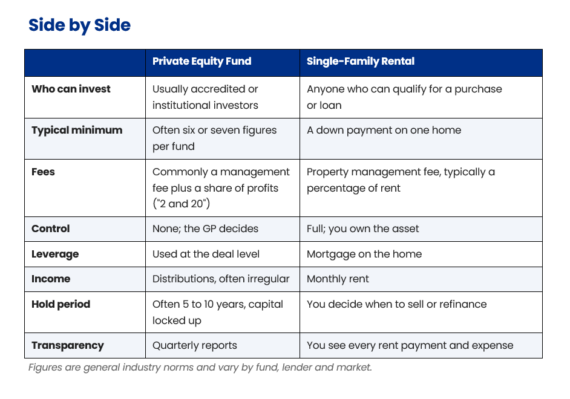
Where the Rental Owner Has the Edge
In some ways, owning the asset directly beats owning a slice of a fund.
-
You are the GP and the LP. No one else decides when to buy, sell or refinance. You keep the profits a GP would normally share in.
-
Lower friction. You pay for management, not for a layer of fund fees on top of it.
-
A tangible asset. You can drive by it, inspect it and understand exactly what drives its value. People will always need a place to live.
-
Tax advantages. Rental owners can often deduct mortgage interest, operating costs and depreciation. Talk to a tax advisor about your situation.
-
Flexible exits. A refinance can return capital without selling. A sale can be timed to your goals, not a fund’s deadline.
The Honest Trade-Offs
The comparison is not perfect, and smart investors know where it breaks down.
-
Concentration. A PE fund spreads money across many assets. One rental home is one asset in one market, so a vacancy or a big repair hits harder.
-
Operating burden. In a fund, the GP does the work. As a direct owner, someone has to handle residents, maintenance and turnover.
-
Liquidity. Neither is quick to sell. A home can take weeks or months to sell, and transaction costs are real.
-
Leverage cuts both ways. A mortgage magnifies losses as well as gains if values or rents fall.
The fix for most of these is the same one PE uses: professional operators and a portfolio that grows over time.
Closing the Gap: New Construction and Professional Management
The best PE firms win on two things: buying the right assets and operating them well. Everyday investors can borrow both.
Start with a better asset. A new construction home comes with builder warranties, modern systems and lower near-term maintenance. That reduces the surprise repairs that make a single property feel risky.
Hire your operator. A professional property manager plays the GP’s operating role. They screen residents, set rents, handle maintenance and send you reports, while you keep ownership and control.
Build a portfolio over time. One home becomes two, then five, across different markets. That is how a fund of one starts to look like a real fund, with diversification to match.
This is the model Marketplace Homes is built around: new construction single-family rentals, acquired and professionally managed for investors across 33 states and 60+ markets.
Private Equity, Without the Velvet Rope
You do not need a seven-figure check or an invitation to a fund to invest like private equity. You need a solid asset, sensible financing, strong operations and the patience to let value build.
A single-family rental home delivers all four. Pair it with a professional operator, and you get the PE playbook with something most LPs never have: full ownership and control.
Ready to build your own fund of one? Talk with a Marketplace Homes Solutions Consultant about new construction rental homes in markets that fit your goals.
This article is for educational purposes only and is not investment, tax or legal advice.