

By Mike Tamulevich, COO, Marketplace Homes · October 21, 2026
Most investors look at a property management fee and see a cost. I look at it and see a price, and the question is whether you are getting a good deal. When you add up the hours, the risk, and the money a self-managing landlord leaves on the table, roughly $2,000 a year to have a professional run your rental is one of the best values in real estate.
The mistake I see over and over is that investors compare the management fee to zero. But self-managing is never free. You just pay for it in a currency that doesn’t show up on your P&L: your time, your weekends, and your exposure.
How much time self-managing really takes
The industry rule of thumb is about 8 hours a month per rental, and in a real month it is often closer to 15. The baseline is roughly 4 hours a month on day-to-day management plus about the same again on leasing and turnover, or around 96 hours a year if the home turns over annually (Hemlane). An owner survey by Real Property Management landed almost exactly there: 47.5 hours a year on leasing and 46.6 on management.
That baseline assumes everything goes smoothly. Landlords who track every text, drive-by, vendor call, and hour spent reading up on local rules often find the real number is 15 or more hours a month, especially in a turnover year (VerticalRent).
The hours also don’t arrive evenly. You might do nothing for six weeks, then lose a weekend to a burst pipe, a late-paying tenant, or a move-out that needs paint, cleaning, photos, listing, showings, screening, and a new lease. That is the part spreadsheets miss: self-managing isn’t a part-time job with set hours. It’s being on call.
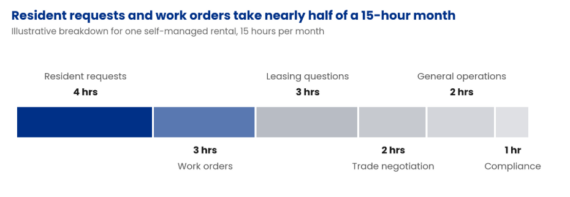
Your mix will vary month to month, but the pattern holds: most of the time goes to responding to people and problems, not to anything that grows your return.
Now picture those same hours going somewhere else:
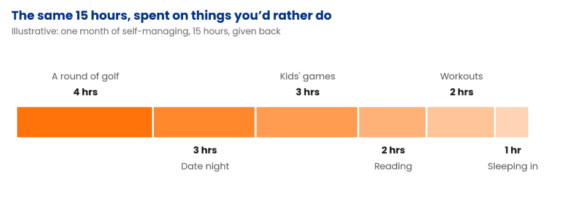
That’s the real trade. A management fee doesn’t just buy back hours; it buys back the ones you’d most like to have.
The math: what is an hour of your time worth?
If you self-manage to save a $2,000 annual fee, you are paying yourself between $11 and $21 an hour to do it. At 8 hours a month (96 a year), $2,000 works out to about $21 an hour. At 15 hours a month (180 a year), it’s about $11 an hour. Ask yourself whether you would take a second job at that wage, with nights and weekends on call.
Flip it around and price your hours at what you actually earn:
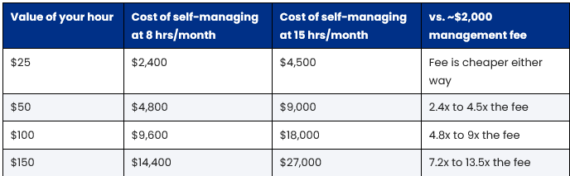
For most of the professionals I work with, a physician, an engineer, a business owner, the honest number is $100 an hour or more. At that rate, a $2,000 fee is buying back roughly $10,000 to $18,000 of time every year. That isn’t an expense. That’s an arbitrage.
The costs that never show up on your time sheet
Hours are the easy part to measure. The bigger risk of self-managing is the mistakes that cost far more than a year of fees.
-
Fair housing exposure. One wrong sentence in a listing, a showing, or a screening decision can become a complaint. Professional managers use written, consistent screening criteria applied the same way to every applicant.
-
Legal and compliance missteps. Security deposit rules, required notices, habitability standards, and eviction procedures vary by state and city. Get one step wrong and you can lose a case you should have won, or owe damages.
-
Vacancy. Every month a home sits empty costs you a full month of rent. On a $2,000 home, one extra month of vacancy wipes out a full year of management fees. Pricing a home right and filling it fast is where a manager earns their keep.
-
Tenant quality. A bad placement can mean months of unpaid rent, legal fees, and turnover repairs. Screening is the single highest-leverage decision in the life of a rental.
-
Maintenance pricing and response. A manager with hundreds of homes has vetted vendors, negotiated rates, and a 24/7 line. You have Google and whoever calls you back.
None of these are hypothetical. They are the situations that send self-managing investors looking for help, usually after the expensive lesson.
The math gets worse as you grow
One rental is a side project. Five is a part-time job, and ten is close to a full-time one. At 8 to 15 hours per home, a five-home portfolio is 40 to 75 hours a month. A recent UK survey of landlords found those with 11 or more properties spend around 78 hours a month managing them, nearly ten working days (Pegasus Insight via The Negotiator).
Distance makes it harder still. Many of our investors buy new construction in markets hundreds of miles from home because that’s where the numbers work. You can’t drive by, meet a plumber, or walk a move-out inspection from another state. Out-of-state investing without local management isn’t really self-managing. It’s hoping.
When self-managing does make sense
To be fair, self-managing can be the right call for some investors. It tends to work when:
-
You own one or two homes close to where you live
-
You have a long-term, reliable tenant and low turnover
-
You’re handy, have flexible time, and genuinely enjoy the work
-
You’ve taken the time to learn your state’s landlord-tenant law
If that’s you, great. But be honest about whether that description still fits in three years, after a job change, a second or third property, or a move.
And if self-managing is going great, awesome. Even so, do yourself a favor and have a conversation with a quality property manager. A second set of eyes might catch rent you’re leaving on the table, a compliance gap you didn’t know about, or a cost you could cut. Worst case, you confirm you’re on the right track.
Hiring a manager is only worth it if you hire the right one
A bad property manager can cost you more than managing it yourself. Slow leasing, weak screening, marked-up repairs, and poor communication erase every benefit in this article. So the decision isn’t just whether to hire a manager. It’s who.
Before you sign, ask:
-
What do you charge beyond the monthly fee? Leasing, renewal, maintenance coordination, and eviction fees vary widely.
-
How fast do you lease homes, and at what rent? Days on market and rent achieved matter more than the fee percentage.
-
How do you screen residents? Look for written, consistent criteria.
-
Who are your vendors, and how are they priced? You want negotiated rates, not markups.
-
What will I see, and how often? Monthly statements, inspection reports, and a named point of contact.
Where you actually make money in real estate
You make your money in real estate in three places: buying at the right price, managing efficiently, and selling or trading at the right time.
-
Buy right. The purchase price and the rent it supports set your return before you ever get the keys. You can’t manage your way out of overpaying.
-
Manage efficiently. This is where the right manager earns their fee: less vacancy, better residents, controlled costs, and a well-maintained asset.
-
Exit at the right time. Selling or trading through a 1031 exchange at the right point in the market is where much of the wealth is realized.
A good manager drives the middle step, but helps with the other two as well. Their rent and leasing data sharpens your next purchase, and a well-documented, well-kept home is worth more when it’s time to sell or trade. Hire for all three.
The bottom line
A property manager isn’t a cost you add to your investment. It’s the price of turning a rental into an actual investment instead of a second job. For around $2,000 a year, you buy back 100 to 180 hours, transfer much of the day-to-day legal and operational risk to professionals, and get a team whose job is to keep your home leased and your tenant happy.
When I was in financial services, nobody asked whether they should pay someone to execute their trades. Real estate deserves the same discipline: put your time where it earns the most, and let professionals handle the rest.
If you’re weighing self-management against hiring a pro, the team at Marketplace Homes is happy to walk through the numbers on your specific property.
Sources:
-
Hemlane: 6 Explanations to the Cost and Time of Property Management
-
VerticalRent: The True Cost of Self-Managing Rental Properties
-
The Negotiator: Landlords spend four working days a month managing property