
Phoenix investors — this one’s for you.
If you’ve been researching Phoenix real estate investment in 2026, you’ve probably run into two very different takes: breathless optimism from people trying to sell you something, and doom-and-gloom warnings from people who’ve been calling a crash since 2022. Neither camp is giving you the full picture.
The real question investors are asking is simpler: Is Phoenix still worth it? After the boom, the correction, and the slow grind back to balance, a lot of real estate investors are wondering whether they missed the window — or whether a new one is opening right now.
Here’s the honest answer: Phoenix remains one of the most fundamentally sound real estate investment markets in the country. But 2026 rewards strategy over speed. The era of buying anything and watching it double is behind us. What’s ahead is actually better for serious, long-term investors who know how to underwrite a deal.
Let’s walk through the data.
Phoenix Real Estate Market Overview: Where Things Stand in 2026
Before diving into strategy, it helps to understand exactly where the Phoenix housing market stands right now.
The Greater Phoenix median home price hit approximately $444,740 in January 2026 — roughly flat year-over-year — with about 24,358 active listings and 5.17 months of supply. Days on market have extended to around 94 days on average, a dramatic shift from the frenzied pace of 2021–2022. That means investors have real negotiating leverage today that simply didn’t exist a few years ago.
That’s not a crash. That’s a market correcting toward fundamentals — and for buyers, it’s a meaningful window.
Home values across the Phoenix metro are projected to grow 3.5%–5.5% through 2026, driven by continued population inflows and structural undersupply of affordable and mid-tier housing. Compare that median price to Los Angeles ($850K+), San Francisco ($1.2M+), or Seattle ($750K+) and Phoenix still represents significant relative value for the economic fundamentals you’re getting. That affordability gap continues to drive domestic relocation demand that feeds directly into the rental pool — which is the fuel that makes buying a home to rent out in Phoenix a viable long-term strategy.
The Population Story: Still Growing, Still Powerful
When evaluating any real estate investment market, population growth is the foundational metric. It determines whether housing demand is structural or speculative — and in Phoenix, the answer is firmly structural.
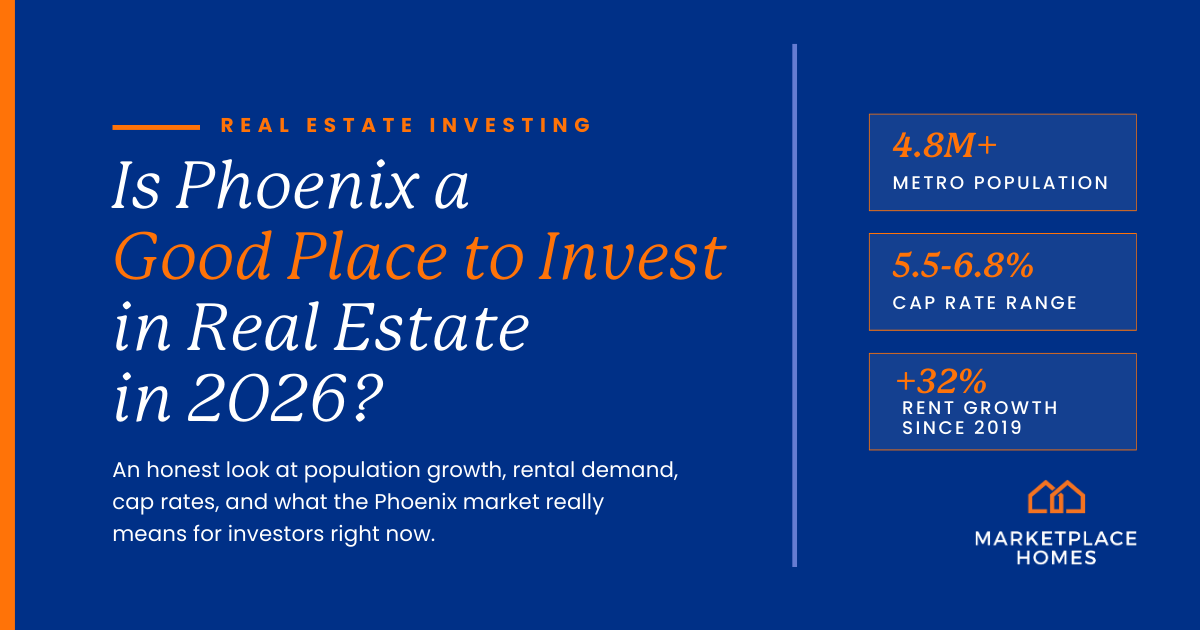
The Greater Phoenix metro has crossed 4.8 million residents as of 2025, with city-level population sitting around 1.7 million. Growth is averaging roughly 1.3–1.5% per year, fueled by domestic migration from California, Illinois, and Washington, alongside significant international in-migration. In 2024 alone, the metro added approximately 85,000 people through net migration — a 15-year high.
The long arc is even more compelling. Arizona’s state population is projected to grow from 7.7 million today to nearly 9.8 million by 2060, with the Greater Phoenix metro expected to represent nearly 73.5% of the entire state’s population by that point. That’s not just growth — it’s concentration. Jobs, infrastructure, economic activity, and housing demand will continue gravitating to this metro for decades.
For investors evaluating Phoenix as a long-term rental market, that demographic pipeline is the single most important variable. People need places to live. More people means more sustained demand for rental housing — and a lower-risk environment for long-term hold strategies.
The Phoenix Jobs Picture: Diversification Changes Everything
One of the most important shifts in Phoenix’s investment thesis over the past decade is economic diversification — and it’s a story most investors outside the market don’t fully appreciate.
The semiconductor industry has permanently changed Phoenix’s economic profile. The TSMC campus in north Phoenix is now a major economic anchor, drawing a pipeline of advanced manufacturing suppliers, tech firms, and high-income workers into the metro. Advanced manufacturing accounts for roughly 154,000 jobs in Greater Phoenix, placing it among the top national markets for semiconductor and aerospace employment. Healthcare has expanded substantially as well, with the metro now supporting around 343,000 healthcare and social assistance jobs — up 20,000 year-over-year.
Phoenix MSA job growth is forecast to return to 1.6% in 2026 after a modest slowdown in 2025, with nominal personal income growth projected to reach 5.7%. Translation: the workforce is growing, diversifying, and earning more — which is exactly the kind of tenant base that supports stable rental demand and long-term Phoenix investment property performance.
A diverse, well-employed local economy also means Phoenix is less vulnerable to sector-specific shocks than single-industry markets. That matters deeply for investors with a 5–10 year hold horizon.
Phoenix Rental Market 2026: The Honest Numbers
This is where Phoenix rental property investors need to be clear-eyed — because the rental story in 2026 is genuinely nuanced, with real headwinds in some segments and strong tailwinds in others.
The Headwind: A Multifamily Supply Surge
A significant apartment construction boom delivered roughly 25,000 new multifamily units in 2024 alone — more than double the 10-year historical average. That supply wave created real pressure on the apartment sector. Multifamily vacancy ticked up to 12.6% in Q4 2025, and average effective rents in some apartment segments softened roughly 3% year-over-year. The past two years have been challenging for owners of oversupplied Class A downtown apartments.
The Turning Point: The Pipeline Is Contracting Fast
That same construction surge is now reversing sharply. New groundbreakings fell 52% in 2024 vs. 2023. Units under construction dropped 29% year-over-year. The supply wave is rolling through — and once it clears, the structural rental demand story reasserts itself. Analysts project Phoenix rent growth to return toward its historical average of approximately 5% annually by 2026–2027 as the excess supply gets absorbed.
What This Means for Single-Family Rental Investors
For investors focused on single-family rental properties in Phoenix — rather than large apartment complexes — the picture looks notably different. Average effective rent across the Phoenix market reached $1,606/month as of early 2025, a 32% increase from year-end 2019 levels. Single-family vacancy has remained considerably tighter than the apartment market throughout the supply surge. Neighborhoods with strong organic demand and limited new construction are already seeing rent growth resume.
Cap rates across Phoenix are running 5.5%–6.8% depending on submarket and asset condition — competitive with most Sun Belt peers, and meaningfully better than coastal gateway markets.
Has Phoenix Peaked? The Answer Investors Actually Need
This is the real question beneath every “is Phoenix a good place to invest” search. So let’s answer it directly.
Phoenix peaked as a speculative market. It has not peaked as a fundamental one.
The conditions that typically precede a genuine real estate market crash — widespread job losses, dramatic oversupply of for-sale housing, deteriorating lending standards — are not present in Phoenix. What you have instead is a market recalibrating after an extraordinary pandemic-era run. That’s a very different animal from a structural breakdown.
The lock-in effect is keeping resale supply constrained. Most Phoenix homeowners hold mortgages well below today’s rates and have no financial incentive to sell. New single-family construction is running far below the overbuilding pace of the 2000s — restrained by higher financing costs, labor shortages, and zoning bottlenecks. The result is a for-sale market that remains structurally undersupplied even as buyer activity has moderated.
National real estate and economic reports have ranked Phoenix among the Top 10 U.S. markets to watch in 2026 — not because of hype, but because of genuine structural fundamentals: sustained population growth, economic diversification, and a durable affordability advantage over coastal metros.
The investors who’ve historically been rewarded in Phoenix are the ones who buy at rational prices, underwrite conservatively, and hold for the long cycle. That playbook still works in 2026. It just requires more patience and precision than it did four years ago.
Appreciation vs. Cash Flow: Which Type of Phoenix Investor Are You?
Phoenix real estate investing in 2026 is not a one-strategy market. Your investment thesis determines whether — and how — you belong here.
Appreciation Investors
If your primary goal is long-term property appreciation, Phoenix makes a compelling case. Population-driven demand, economic diversification, structural undersupply of for-sale housing, and ongoing infrastructure investment all support a durable appreciation story. Emerging submarkets like South Phoenix, West Phoenix, and outer suburbs like Buckeye and Queen Creek are still earlier in their growth cycles — the kind of positioning that has historically preceded strong equity gains in this metro.
For investors looking to enter with less capital upfront, it’s worth exploring how to buy investment property with no money down or how to buy an off-market property — both strategies that can improve your entry basis in a market where negotiating room now exists.
Value-Add and Fix-and-Flip Investors
Phoenix has long supported a strong fix-and-flip market, and 2026 conditions — more inventory, longer days on market, motivated sellers — are actually favorable for value-add strategies. Knowing how to find houses to flip and having a clear-eyed picture of the true cost to flip a house are non-negotiables before executing this strategy anywhere. Understanding which home styles work best for landlords and investors can also prevent costly mistakes when evaluating properties.
Pre-foreclosure inventory is beginning to move in Phoenix as well. Learning how to find pre-foreclosure homes gives investors access to motivated sellers and below-market entry points before properties ever hit the MLS.
Long-Term Cash Flow Investors
Cash flow investing in Phoenix in 2026 requires discipline — but the opportunities are real. Investors who define a clear buy box — specific price range, minimum rent-to-value ratio, target neighborhoods — are still finding properties that pencil in the right submarkets. Areas like South Phoenix, Maryvale, West Phoenix, and the Peoria corridor offer the strongest rent-to-price ratios and the most upside as the supply overhang clears over the next 12–18 months.
The tax dimension adds a meaningful layer to the return profile. The return of 100% bonus depreciation under current tax law means qualifying Phoenix rental properties can function as effective real estate tax shelters — a factor that’s driving renewed investor activity from high-income earners seeking both income and tax efficiency from the same asset.
Build-for-Rent Investors
One of the most compelling emerging strategies in Phoenix is build-for-rent — purpose-built single-family homes designed from the ground up as rental properties. Phoenix’s development-friendly zoning, active new construction pipeline, and sustained renter demand make it one of the top metros nationally for this strategy. If you’re evaluating investing in new home construction, it’s worth understanding how new houses depreciate and how to build that into your long-term underwriting model.
Best Submarkets for Real Estate Investment in Phoenix in 2026
Not all of Phoenix performs the same. Submarket selection is the single most important variable for Phoenix investment property performance in 2026 — more important than timing the market, more important than the asset class.
The most common mistake out-of-state investors make in Phoenix is treating it as a monolithic market — paying peak prices in oversupplied pockets while missing the neighborhoods with genuine upside. If you’re sourcing deals actively, learning how to find off-market real estate deals can surface inventory that never hits Zillow — often at meaningfully better pricing than listed properties.
| Submarket | Best For | Notes |
|---|---|---|
| South Phoenix | Value-add, Cash Flow | Strong rent growth, below-median entry prices |
| Maryvale | Cash Flow, Long-Term Hold | High renter demand, improving infrastructure |
| West Phoenix / Peoria Corridor | Cash Flow, Appreciation | Expanding employment base, new development |
| Buckeye / Goodyear | Appreciation, New Construction | Fastest-growing outer suburbs, strong family demand |
| North Phoenix | Appreciation, STR | Near TSMC campus, high-income tenant base |
| Mesa / Gilbert / Chandler | Buy-and-Hold | Mature, stable submarkets with strong school districts |
| Downtown / Midtown Phoenix | ⚠ Proceed Carefully | Oversupplied Class A apartments, softening rents |
Key Risks for Phoenix Real Estate Investors in 2026
A credible analysis of investing in Phoenix real estate has to include the real risks.
Overpaying is the #1 investor risk. With more inventory on the market than in recent years, there is no strategic reason to overpay or waive due diligence. Underwrite based on current market rents — not the peak rents of 2021–2022 — and stress-test your numbers against a range of vacancy and rate scenarios before committing.
Water and climate risk is a legitimate long-term consideration for Arizona. Phoenix has invested substantially in water infrastructure and alternative sourcing, but investors with 20–30 year horizons should factor it into their market thesis.
Short-term rental regulation risk is real and evolving. Scottsdale, Tempe, and Phoenix proper operate under different STR frameworks, and city-level rules continue to change. Verify current regulations at the city level before executing an STR strategy.
Tenant screening and landlord legal exposure is something every Phoenix investor needs to understand before closing on a rental property. Professional tenant screening protects your asset and your cash flow — and understanding the legal landscape for landlords in your market is part of running a real investment operation.
Frequently Asked Questions: Phoenix Real Estate Investment 2026
Is Phoenix a good place to invest in real estate in 2026? Yes — for long-term, fundamentals-driven investors. Phoenix offers consistent population growth, economic diversification, relative affordability versus coastal markets, and cap rates of 5.5–6.8% in the right submarkets. It is not a short-term speculation play; it’s a hold-for-the-cycle market that rewards patience and precision.
Is the Phoenix housing market going to crash in 2026? Most analysts don’t see the conditions for a genuine market crash. There is no mass oversupply of for-sale homes, no significant job loss environment, and no deterioration in lending standards. The market is normalizing after the pandemic run-up — a recalibration, not a collapse.
What are cap rates in Phoenix in 2026? Cap rates in Phoenix are running approximately 5.5%–6.8% depending on submarket and asset type. Single-family rentals in emerging neighborhoods like South Phoenix and Maryvale tend toward the higher end of that range.
What is the average rent in Phoenix in 2026? Average effective rent is approximately $1,529–$1,606/month across Phoenix as of late 2025/early 2026 — up roughly 32% from 2019 levels, despite recent softening in the Class A apartment segment.
What is the median home price in Phoenix in 2026? The Greater Phoenix median home price was approximately $444,740 as of January 2026 — roughly flat year-over-year, with around 94 days on market and 5.17 months of supply.
Is Phoenix better for appreciation or cash flow investing? Both strategies work in Phoenix, but in different submarkets. Outer suburbs like Buckeye and North Phoenix tend to favor appreciation plays. Inner-ring transitional neighborhoods like South Phoenix, Maryvale, and West Phoenix offer better rent-to-price ratios for cash flow investors. Match your buy box to your thesis.
The Bottom Line: Is Phoenix Worth It for Investors in 2026?
Phoenix is not the rocket ship it was in 2020. It’s something more durable: a structurally sound, economically diversifying, population-growing market that rewards patient, strategic investors.
The investors who succeed in Phoenix real estate in 2026 will define a clear buy box, underwrite conservatively based on current rents, target the right submarkets, and hold through the long cycle. They’ll take advantage of the negotiating leverage that today’s balanced market conditions offer — leverage that historically shrinks once spring buying activity tightens inventory back up.
The fundamentals that have made Phoenix one of the most-watched real estate investment markets in the country for two decades are firmly in place. The question isn’t whether Phoenix is a good place to invest. The question is whether you’re positioned to execute with the discipline this market now demands.
Marketplace Homes specializes in real estate investment properties across growth markets. Interested in evaluating a Phoenix investment? Contact our team to talk strategy.