
You’ve heard the names on every investor podcast: Detroit. Atlanta. Phoenix. Dallas. These are the markets that dominate the conversation — and for good reason. But the investors quietly building portfolios in 2026 aren’t always following the loudest voices. They’re looking two steps ahead, into markets that haven’t been bid up yet, where the fundamentals are solid and the competition is thinner.
Two markets most investors are sleeping on: Grand Rapids, Michigan and Birmingham, Alabama.
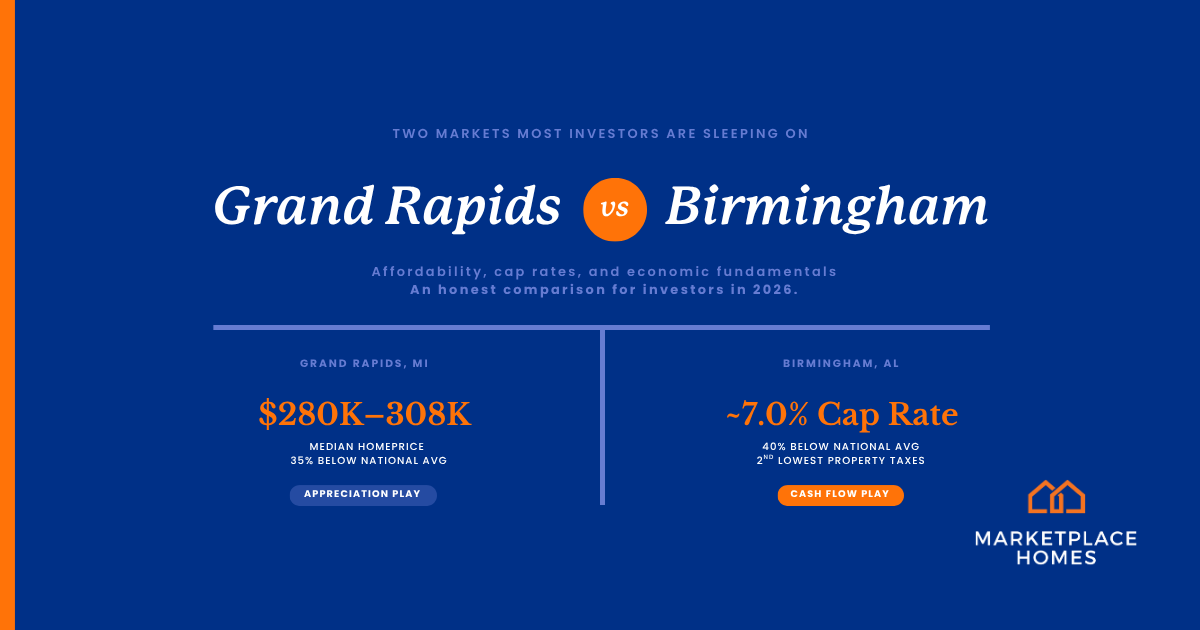
One sits in the Midwest with a $280K median price, a 1.18-month supply of inventory, and a Medical Mile that’s reshaping the city’s economic identity. The other is a cash flow powerhouse in the Southeast where the average home is 40% more affordable than the national average, cap rates are running near 7%, and UAB’s $12.1 billion annual economic impact underpins demand you can actually underwrite.
These aren’t hype plays. They’re fundamentals plays — the kind of markets that reward investors who do the research before everyone else does.
Let’s break them down.
Grand Rapids, Michigan: The Midwest’s Most Underrated Growth Market
The Case in One Line
Grand Rapids offers coastal-city job diversity, Midwest affordability, and some of the tightest inventory conditions in the country — in a single market that most national investors haven’t put on their radar yet.
The Numbers
The median home price in Grand Rapids sits around $280,000–$308,000 heading into 2026 — roughly 35% below the national average — while homes are selling in approximately 20–51 days depending on segment and pricing. Active inventory sits at just 386 homes as of February 2026, with only 1.18 months of supply. For context, a balanced market requires 5–6 months. Grand Rapids is running at less than a quarter of that.
Price appreciation has been steady rather than volatile: 68.8% between 2019 and 2024, with forecasts calling for approximately 3.2% appreciation through 2026 — meaningful, durable growth without the boom-bust risk of overheated Sun Belt metros.
Average rent sits at approximately $1,545/month as of February 2026 (down a modest 0.49% year-over-year), with single-family homes outperforming the apartment segment. That $1,545 average on a $300,000 purchase price gives investors a competitive rent-to-value ratio for a Midwest market of this quality.
The Economic Story
Grand Rapids’ economic transformation is the story most investors outside Michigan don’t know. The city long carried the identity of a furniture manufacturing hub. That’s not the story anymore.
Today, Grand Rapids is anchored by one of the most impressive healthcare corridors in the Midwest. Corewell Health, Trinity Health, and Spectrum Health form the backbone of the Medical Mile — a concentration of hospitals, research institutions, and bioscience employers that produces stable, high-income employment year-round. Healthcare, education, and professional services now drive the local economy alongside strong manufacturing. Grand Valley State University, Calvin University, and Aquinas College add a consistent pipeline of young renters and first-time buyers to the market.
Job growth over 2019–2024 was +3.1%, and the city consistently attracts Millennial and Gen Z workers priced out of Chicago and Detroit — 35.6% of Grand Rapids Millennial renters can afford to buy, compared to a national average of 29.7%. That transition from renter to owner fuels resale demand and keeps single-family rentals occupied throughout the buying cycle.
A significant near-term catalyst: the Fulton and Market riverfront mixed-use development, estimated at nearly $800 million, is one of the largest single investments in Grand Rapids history. Infrastructure of this scale typically drives property value appreciation in adjacent neighborhoods for years following completion. Investors who enter before these projects fully mature typically capture the strongest equity gains.
The Rental Market
Grand Rapids’ rental market in 2026 is defined by tight supply in the single-family and B-class segment and modest softness in newer apartment product — a pattern that should be familiar to investors who watched Phoenix’s multifamily cycle play out.
The lock-in effect is acute here. Most Grand Rapids homeowners hold mortgages in the 2–3% range and have no financial incentive to sell at today’s rates. With only 550–650 active listings on the market at any given time, inventory is unlikely to meaningfully loosen unless rates fall below 5.5%. That persistent supply constraint keeps rental demand elevated across starter-home neighborhoods like Garfield Park and Alger Heights — areas where median prices in the mid-$200,000s still make cash flow math achievable.
For investors evaluating entry, the Midwest’s landlord landscape is worth noting. Understanding how to find pre-foreclosure homes in constrained markets like Grand Rapids can surface motivated seller inventory that never reaches the MLS — a meaningful edge when active listings number in the hundreds.
Best Neighborhoods for Grand Rapids Investors in 2026
- Garfield Park / Alger Heights — Starter-home pricing, strong first-time buyer and renter demand, mid-$200Ks entry point
- Wyoming / Kentwood — Suburban stability, steady demand, newer housing stock
- Medical Mile corridor — High-income tenant base, strong occupancy tied to healthcare employment
- East Grand Rapids / Rockford — Premium pricing, appreciation-focused, lower cash flow but strong hold value
The Honest Risk
Grand Rapids is not a cash flow market in the traditional sense. At a $300K purchase price and $1,545/month average rent, you’re not finding 1%-rule deals. This is a appreciation and stability play — suited for investors with a 5–10 year horizon who want durable equity growth in a market that doesn’t crater when the national mood turns.
The one segment to watch with caution: downtown condominiums. Local analysts project a modest 4.8% price correction in that segment by late 2026. Single-family homes and outer-ring suburbs remain on solid footing.
Grand Rapids vs. Birmingham: Side-by-Side
| Metric | Grand Rapids, MI | Birmingham, AL |
|---|---|---|
| Median Home Price | ~$280K–$308K | ~$148K–$265K (city vs. metro) |
| vs. National Average | 35% below | 40% below (metro) |
| Average Rent | $1,545/month | $1,362/month |
| Cap Rates | Competitive Midwest range | ~7.0% (multifamily); higher on SFR |
| Home Value Growth | +68.8% (2019–2024); +3.2% projected 2026 | +130% since 2014; +75% last 5 years |
| Inventory (Months of Supply) | 1.18 months — critically tight | 2.2 months — below balanced market |
| Key Economic Anchor | Medical Mile (Corewell, Trinity, Spectrum Health) | UAB ($12.1B annual economic impact) |
| Property Taxes | Moderate | 2nd lowest in the nation |
| Best Investor Strategy | Appreciation Long-term hold, equity growth | Cash Flow Buy-and-hold, SFR yield |
| Population Growth | ~0.4% metro (2025); steady in-migration | +21% metro (2010–2024); 110% faster than national avg |
| Biggest Risk | Limited cash flow at current prices | Neighborhood selection; modest appreciation |
| Ideal Hold Period | 5–10 years | 5–7 years (cash flow from day one) |
Birmingham, Alabama: The Southeast’s Best Cash Flow Market
The Case in One Line
Birmingham is the market where the numbers investors are looking for everywhere else — strong cap rates, low entry prices, durable rental demand — actually still exist.
The Numbers
Birmingham’s median sale price was approximately $148,000–$265,000 depending on the segment and geography (city vs. metro), with the overall metro 40% more affordable than the national average. That’s not a typo. For investors who have watched entry prices climb past $400K in most Sun Belt markets, Birmingham is a different world.
Average rent sits at approximately $1,362/month as of early 2026, up 2.51% year-over-year — modest growth, but growth on an asset class that costs a fraction of what comparable properties run in Atlanta, Nashville, or Charlotte. Multifamily cap rates in Birmingham are running near 7.0% — roughly 50–100 basis points above the national average. That spread matters, especially in a rate environment where financing costs remain elevated.
Home values have appreciated 130% since 2014 and 75% over the past five years, with median rents up 41% over the same period. This isn’t stagnation — it’s steady, disciplined growth that compounds without drawing the speculative capital that inflates and then deflates other markets.
The Economic Story
Birmingham has historically been undersold by investors who associate it with legacy industrial decline. That framing is outdated. Today, Birmingham is a healthcare, finance, manufacturing, and logistics hub anchored by institutions of national significance.
UAB (University of Alabama at Birmingham) is the largest employer in the state, with an annual economic impact exceeding $12.1 billion. It employs over 20,000 people and generates a constant flow of tenants: medical professionals, researchers, students, and university staff who need quality housing within commuting distance. UAB’s presence acts as a demand floor — even in softer economic cycles, the medical district keeps renting.
Birmingham has also emerged as a meaningful player in electric vehicle manufacturing and supply chain. Since 2018, over $725 million in mobility-related investment has created 2,200+ jobs, led by Mercedes-Benz’s partnerships with UAB and Alabama Power. That’s the kind of economic diversification that changes a market’s long-term trajectory. For 2025, forecasters projected the Birmingham-Hoover MSA to add 3,700–8,100 new jobs — meaningful growth for a metro of 1.2 million people.
Alabama’s second-lowest property taxes in the nation make the math work even further in investors’ favor. Lower operating costs mean more of your gross rent translates to net operating income — which is why Birmingham turnkey single-family rentals from established operators can trade in the $120,000–$160,000 range and still produce strong cash-on-cash returns.
The Rental Market
Birmingham’s rental story in 2026 is similar to Grand Rapids in one important way: there are nuances by segment, and investors who ignore them will make expensive mistakes.
The honest headwind is in multifamily. A wave of new apartment deliveries — over 2,200 units completed in the past year, well above the 10-year annual average of 860 — pushed vacancy to 13.0% in Q3 2025 and put modest downward pressure on asking rents (down 0.3% in Q3). Construction starts have slowed considerably, and the pipeline is expected to shrink into 2026, setting up a rebalancing that analysts project will stabilize rents as the year progresses.
The opportunity for single-family rental investors is notably different. SFR vacancy is tighter, tenant quality near job nodes is strong, and the rent-to-price ratios in Birmingham’s B-class neighborhoods are among the best in the Southeast. Highland Park, Southside, and Forest Park offer a mix of historic homes, professional tenants, and proximity to UAB that produces reliable occupancy and steady rent collection.
For investors buying a home to rent out for the first time, Birmingham’s turnkey market is one of the most accessible in the country. Properties are often already renovated, tenant-occupied, and professionally managed, meaning investors can generate cash flow from day one. Professional tenant screening is especially important in a market where tenant quality varies significantly by neighborhood — getting the right renter in place protects returns throughout the hold.
The tax shelter dimension matters here too. Alabama’s low property taxes, combined with the return of 100% bonus depreciation under current federal tax law, make Birmingham rentals particularly efficient for high-income investors looking to offset W-2 income. It’s a market where the after-tax return can look meaningfully different from the pre-tax number.
Best Neighborhoods for Birmingham Investors in 2026
- Highland Park / Southside — 65% renter occupancy, professional tenant base, proximity to UAB; strong B-class SFR demand
- Forest Park / Crestwood South — Suburban stability, family rentals, median sale prices around $320K with strong rent-to-value
- East Pinson Valley / Central City — Lower entry prices, value-add opportunity, high renter demand
- Downtown / Medical District — Steady institutional tenant base from UAB and medical employers; new construction pipeline thinning
The Honest Risk
Birmingham is primarily a cash flow market, not an appreciation play. Price appreciation historically tracks close to inflation — meaningful over time but not the kind of equity-building machine that Sun Belt appreciation markets have offered. Investors expecting Phoenix-style value gains in Birmingham will be disappointed.
The other risk is neighborhood selection. Birmingham’s investment thesis varies dramatically by zip code. Properties in the wrong neighborhoods carry higher vacancy risk, higher insurance costs, and more difficult tenant management. A clearly defined buy box — neighborhood criteria, minimum rent-to-value, property class — is non-negotiable before deploying capital here.
Which Market Is Right for You?
Choose Grand Rapids if: You’re a long-term appreciation investor who wants Midwest stability, economic diversification, and a market that won’t crater — and you’re comfortable with a 5–10 year hold horizon without expecting aggressive near-term cash flow.
Choose Birmingham if: You’re a cash flow investor who wants strong cap rates, low entry prices, and an asset class that produces income from day one — and you’re willing to do the submarket homework that separates the high-performing zip codes from the underperforming ones.
The honest answer for most investors: These aren’t competing markets. They serve different investment strategies, and a diversified portfolio could include both — Grand Rapids for appreciation stability, Birmingham for cash flow and yield. Both sit well outside the overcrowded tier-one markets where every investor is competing for the same assets at peak pricing.
The investors who win in 2026 won’t be the ones chasing the most-talked-about markets. They’ll be the ones who did the research on the markets no one else is talking about — and moved before the conversation caught up.
If you’re evaluating either market, knowing how to find off-market deals and how to buy investment property with no money down are the two skills that will separate disciplined acquirers from everyone else fighting over listed properties.
Marketplace Homes works with investors across growth markets including the Midwest and Southeast. Interested in exploring Grand Rapids or Birmingham? Contact our team to talk strategy.