

Mike Tamulevich | November 6, 2026
Neither option is simply “riskier.” Buying one home with cash trades away growth to avoid debt, while buying four homes with mortgages trades away stability to multiply growth. The real question is which risks you can afford to carry.
Most investors frame this as “debt is risky, cash is safe.” That view misses half the picture. An all-cash buyer is fully exposed to one home, one neighborhood, one roof and one set of residents. A leveraged buyer spreads that exposure across four homes but takes on fixed monthly obligations that do not care whether the homes are leased.
The numbers below put both paths through the same assumptions, the same good years and the same bad years, so you can see where each one bends and where each one breaks.
The setup
Both investors start with $300,000. Investor A buys one new construction home for cash. Investor B puts 25% down on four identical homes and finances the rest with 30-year fixed investor mortgages.
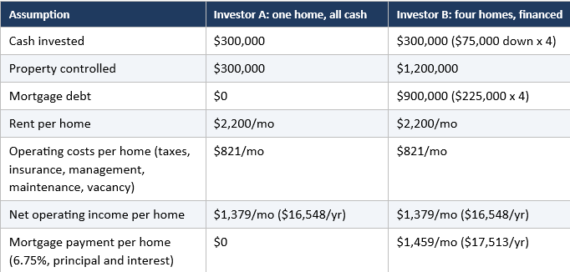
These figures are illustrative. Rents, taxes, insurance and rates vary widely by market, and closing costs, reserves and income taxes are left out to keep the comparison clean. Each of those matters in a real decision, and reserves matter most of all, as you will see below.
Year one, side by side
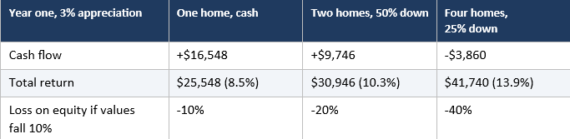
In a normal year with 3% appreciation, Investor B earns about 64% more in total return, but Investor A is the only one getting paid in cash.
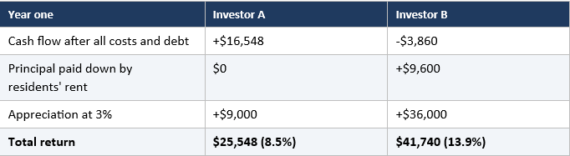
This is the core tradeoff in one table. Investor A collects a steady income stream. Investor B gives up that income, and even writes a small check each month, in exchange for four times the appreciation and principal paydown funded by residents.
Notice that Investor B’s cash flow is slightly negative. When a property’s net yield (5.5% here) is below the mortgage rate (6.75%), borrowing costs more than the property earns in rent alone. The leveraged investor is betting that appreciation, principal paydown and future rent growth make up the difference.
Stress tests: when a year goes wrong
Leverage magnifies bad years just as much as good ones. A 10% price drop costs Investor A about 4% of their capital and costs Investor B about 38%.
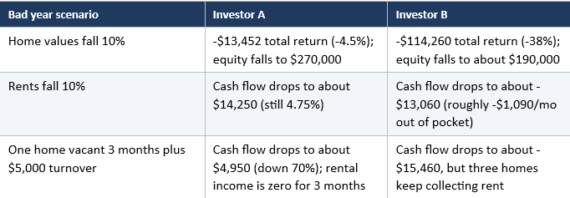
Three lessons stand out.
-
Price drops hurt the leveraged investor far more on paper. But a paper loss only becomes a real loss if Investor B is forced to sell. A fixed-rate mortgage cannot be called because values fell, unlike a margin loan on stocks.
-
Rent drops hit leverage hardest in monthly cash. Investor A’s income shrinks. Investor B’s mortgage payments do not, so the gap comes straight out of pocket.
-
Vacancy hits the all-cash investor hardest in concentration. When Investor A’s only home sits empty, 100% of the income stops. Investor B loses the same dollars, but 75% of the portfolio keeps producing rent.
Resident credit diversification
Four homes do not just spread property risk. They spread the risk across four separate resident households, each with their own employer, income and credit history. One resident’s job loss can stop all of Investor A’s income, but only a quarter of Investor B’s.
Every rental income stream is ultimately a bet on a resident’s ability to pay. With one home, that bet rides on a single household. With four, it is spread across four, much like a lender prefers a pool of loans over one large loan.
To illustrate, assume each resident has a 5% chance in any given year of a serious payment default that ends in nonpayment, eviction and turnover. Assume each default costs about $11,800 (four months of lost rent plus $3,000 in legal and make-ready costs).
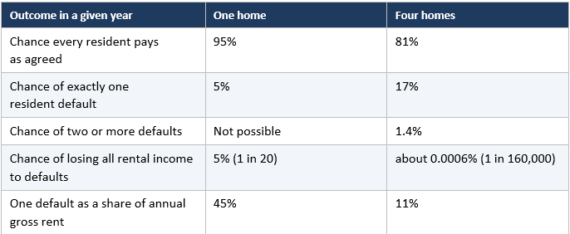
The four-home investor is more likely to deal with a problem resident in a given year, simply because there are more residents. But each problem is far smaller, and the chance of every income stream failing at once nearly disappears. The expected cost per home is identical. What changes is the swing: diversification turns one large, unpredictable hit into smaller, more manageable ones.
Two cautions keep this honest:
-
Defaults are not fully independent. A recession or a major local employer closing can hit several residents at once. Owning homes in different markets, with different local economies, makes resident credit diversification real rather than theoretical.
-
Diversification does not replace screening. Consistent standards for income, credit and rental history on every home are what keep the 5% assumption low in the first place.
This also ties back to leverage. Investor B’s mortgage payments continue through a default, so reserves are what let resident credit diversification do its job without forcing a sale.
The ten-year view
Over ten years, leverage wins clearly if homes appreciate, ties if values stay flat, and loses if values decline for a decade. With these assumptions, the break-even point is roughly zero appreciation.
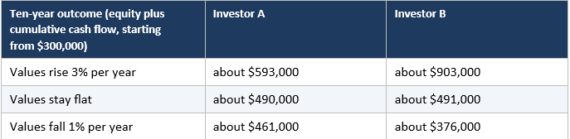
All three scenarios assume rents and operating costs grow 3% per year while the fixed mortgage payment never changes. That is why Investor B’s cash flow turns positive around year three. Rent rises, the payment does not, and inflation quietly works in the leveraged investor’s favor.
Two factors not shown here also favor Investor B. Depreciation is based on the value of the buildings, so four homes create roughly four times the tax deduction. And the mortgage is repaid in future dollars that are worth less than today’s dollars. Selling costs and taxes on a sale would reduce both outcomes.
The risks each path carries
The all-cash investor avoids debt risk but accepts concentration and opportunity risk. The leveraged investor avoids concentration but accepts payment and forced-sale risk.
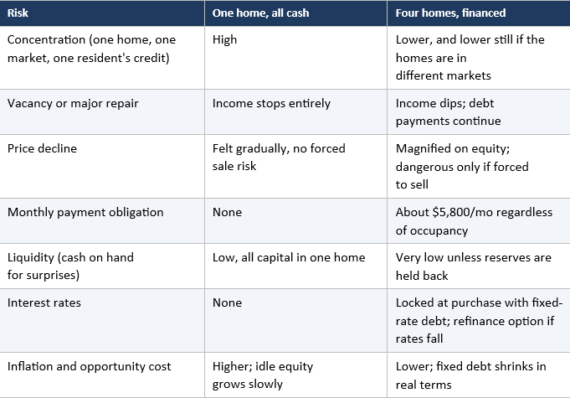
The single biggest danger in the leveraged path is not debt itself. It is being forced to sell at the wrong time because the investor ran out of cash to cover payments during a vacancy, a repair or a soft rental market.
The middle ground, and how to manage leverage risk
This is not an all-or-nothing choice. Two homes with 50% down produce positive cash flow of about $9,750 per year (roughly $810/mo) and a year-one total return of about $31,000 (10.3%), with half the price-drop exposure of the four-home plan.
Whichever level of leverage an investor chooses, these steps reduce the risk of being forced to sell:
-
Hold real reserves. Set aside roughly six months of mortgage, taxes and insurance per home (about $11,000 each in this example). In practice, that means buying three homes instead of four, or keeping cash outside the deal.
-
Use fixed-rate debt. A 30-year fixed loan removes payment shock and cannot be called because values dropped.
-
Diversify across markets. Four homes in four metros are far less exposed than four homes on one street.
-
Favor new construction. Builder warranties and new systems reduce the large, unexpected repairs that strain cash flow in the early years.
-
Ask about financing incentives. A licensed lender, often the builder’s preferred lender, may offer rate buydowns that turn negative cash flow positive.
-
Stress test before you buy. Run the 10% rent drop and the three-month vacancy on your own numbers. If you could not cover those months comfortably, reduce the leverage.
The bottom line
Buying four homes with mortgages carries more volatility, while buying one home with cash carries more concentration and opportunity cost. For an investor with stable income, real reserves and a long time horizon, moderate leverage is often the lower long-term risk. For an investor who needs dependable income or could be forced to sell in a downturn, all cash or light leverage is the safer path.
The right answer depends on the investor, not the spreadsheet. Before choosing, ask three questions: How long can I hold without selling? How many months of payments could I cover with zero rent? How much of my net worth is going into this?
This piece is for educational purposes only and is not financial, tax, or legal advice. All figures are hypothetical and simplified. Consult a licensed lender, tax professional and financial advisor before making investment decisions.