
By Mike Tamulevich, COO, Marketplace Homes
The short answer: a new build neighborhood is a good investment when four things line up. The surrounding market has durable job and population growth. The location gives residents reasonable commutes, good schools, and everyday amenities. The builder has a strong track record and the community allows rentals. And the numbers work at a rent you can actually lease the home for, not a rent you hope for.
New construction removes a lot of the guesswork that comes with resale homes. There is no deferred maintenance, the systems are new, and builder warranties cover the early years. But a brand-new home in the wrong neighborhood is still a weak investment. After more than 20 years of helping investors buy, lease, and manage new construction rentals, we have learned that the neighborhood decision matters as much as the house itself. Getting it right is where we come in.
How Marketplace Homes helps investors choose the right neighborhood
Marketplace Homes is a vertically integrated brokerage and property management company focused on new construction single-family rentals. We work across 33 states and more than 60 active markets, so we see firsthand which communities lease quickly and which ones struggle. Because we also lease and manage the homes, we help investors buy, our Solutions Consultants base their recommendations on real leasing results, not projections. On select builder homes, programs such as our Guaranteed Lease Agreement (GLA) can add certainty to your first year of income.
Here is the framework we use to evaluate a new build community before an investor commits.
1. Start with the market, then zoom in to the neighborhood
A great subdivision cannot overcome a declining metro. Before you look at floor plans, confirm the broader market is moving in the right direction.
-
Job growth and diversity. Look for a metro adding jobs across several industries, not one that depends on a single employer.
-
Population and household growth. People moving in create rental demand. Census estimates and local economic development reports are good starting points.
-
Landlord-friendly laws. Eviction timelines, rent control, and licensing rules vary widely by state and city. They directly affect your risk.
-
Property taxes and insurance. Two markets with similar prices can have very different carrying costs once taxes and insurance are included.
If the market passes, then evaluate the specific community.
2. Check the location fundamentals residents care about
Your residents choose a home based on their daily life. Think like the person who will live there, not just the person who will own it.
-
Commute. Measure drive times to the major employment centers at rush hour. Many new communities sit on the edge of growth, and a commute that feels long today may improve as roads and employers follow. Or it may not. Look for planned infrastructure that is funded, not just proposed.
-
Schools. Families are the core of single-family rental demand. School ratings influence both rent and resale value.
-
Everyday amenities. Grocery stores, healthcare, restaurants, and parks within a short drive make a home easier to lease.
-
Path of growth. Look for new retail, medical, and commercial projects nearby. Builders and national retailers do their own research before choosing a site, and their activity is a useful signal.
3. Evaluate the builder
With new construction, you are betting on the builder as much as the land. A strong builder delivers quality homes, honors warranties, and finishes the community as planned.
-
Track record. How long has the builder been operating in this market? Drive through communities they completed three to five years ago and see how the homes and streets have held up.
-
Warranty and service. Ask how warranty requests are handled and how quickly. As an owner, you want issues resolved without long delays that frustrate residents.
-
Financial strength. Public builders and well-capitalized private builders are less likely to stall a community midway through.
-
Investor friendliness. Some builders welcome investors and offer incentives. Others restrict investor purchases. Know where the builder stands before you fall in love with a lot.
4. Understand the community: build-out, competition, and HOA rules
This is where many new construction investors get surprised. The neighborhood itself can create competition for your home.
-
Phase and build-out timeline. How many homes are planned, how many are built, and how many are still to come? If hundreds of homes will deliver over the next year, you may compete with brand new inventory on both rent and resale.
-
Investor concentration. If many homes in the community are being bought as rentals at the same time, several may hit the leasing market together. That can stretch days on market and pressure rents.
-
HOA rental rules. Read the covenants before you buy. Look for rental caps, minimum lease terms, leasing restrictions, and any approval process for residents.
-
HOA dues and amenities. Pools, clubhouses, and trails help leasing, but they come with dues. Make sure the amenities justify the cost in your numbers.
-
Lot and home selection. Within the same community, a home backing to a busy road or power lines leases differently than one near green space. Popular, practical floor plans tend to lease faster than oversized or unusual ones.
5. Confirm resident demand and a realistic rent
The rent assumption drives every return calculation, so it deserves the most scrutiny.
-
Use real comparables. Look at homes that have actually leased nearby, not just current asking rents. Asking rents tell you what owners hope for. Leased rents tell you what residents pay.
-
Compare like for like. Match bedrooms, square footage, garage, and age as closely as you can. New construction often commands a premium, but only up to a point.
-
Watch days on market. Rentals that sit for 45 days or more in a community are a warning sign about pricing or demand.
-
Underwrite conservatively. A rent you can lease at quickly is worth more than a higher rent that leaves the home vacant for an extra month. One month of vacancy can erase a year of small rent premiums.
At Marketplace Homes, our leasing team prices thousands of homes and sees what actually leases, which is why we underwrite rent based on real resident demand.
6. Run the numbers with every real cost included
A neighborhood can check every box and still fail as an investment if the math does not work. Build your estimate around these line items.
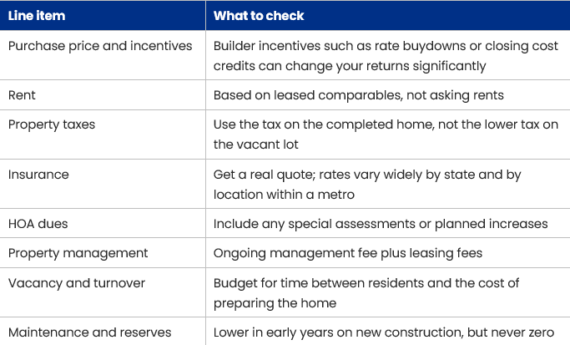
Two cautions on property taxes and insurance. New homes are often taxed on the lot value in the first year, and the bill can jump once the home is reassessed. Insurance is also one of the fastest changing costs in many markets. Underwrite both at their stabilized level.
7. Red flags to watch for
-
HOA covenants that cap or prohibit rentals, or that could be amended to do so
-
A large share of homes in the community listed for rent at the same time
-
Rent projections based only on asking rents or on the builder’s marketing materials
-
A builder with stalled communities or a history of unresolved warranty complaints
-
Heavy dependence on one employer or one industry in the local economy
-
Property taxes or insurance quoted at today’s level with no allowance for reassessment or increases
-
A location that relies on infrastructure that is planned but not yet funded
Quick checklist: is this new build neighborhood a good investment?
-
The metro has diverse job growth and rising population
-
State and local laws are reasonable for rental owners
-
Commute, schools, and amenities appeal to the residents you want
-
The builder has a strong track record and reliable warranty service
-
HOA covenants allow rentals on terms that work for you
-
You know how many homes are still to come and how many will be rentals
-
Rent is based on leased comparables and priced to lease quickly
-
Taxes, insurance, HOA, management, vacancy, and reserves are all in your numbers
-
The investment still works if rent comes in slightly lower or vacancy runs slightly longer
You don’t have to evaluate it alone
Gauging how strong a new build neighborhood is as an investment means looking at it from every angle: the broader market, the city’s growth and policies, the neighborhood itself, the builder’s track record, and ultimately the numbers. Each piece informs the others, and it takes experience to know which signals matter and which are noise. If you’re not yet familiar with spotting these opportunities, working with a team that evaluates them every day can help you avoid costly missteps and move forward with confidence.
Transactions are the result; relationships are the reason. If you are evaluating a new build community, talk to a Marketplace Homes Solutions Consultant before you commit.
Frequently asked questions
Is new construction a good investment for rental property?
It can be. New construction offers lower early maintenance, builder warranties, and strong appeal to residents. The neighborhood, builder, and purchase price still determine whether a specific home is a good investment.
Should I buy in the first phase or a later phase of a new community?
Early phases often come with better pricing and incentives, but you may compete with new homes for years. Later phases have more certainty about how the community turned out. Weigh price against competition.
How do I know if an HOA allows rentals?
Ask the builder for the recorded covenants and HOA rules before you sign a contract. Look for rental caps, minimum lease terms, and resident approval requirements.
What rent should I expect from a new build rental?
Base your estimate on homes that have leased nearby with similar size and features. Price to lease quickly rather than to maximize the asking rent.
What is the biggest mistake investors make with new build neighborhoods?
Underestimating competition. When many investors buy in the same community at the same time, their homes reach the leasing market together, which can lengthen vacancy and pressure rents.