

Mike Tamulevich | October 28, 2026
A rental home bought the year a child is born can be worth roughly $440,000 in equity and cash flow by their 18th birthday, from about $75,000 invested. Bought the year they leave for college, the same idea rarely does more than break even.
I get this question all the time. With kids of my own in this window of life, touring campuses and talking through college plans, the conversations with friends and other parents almost always turn to the same thing: “Should we buy a place near campus instead of paying four years of rent?” It is a reasonable instinct, and I understand why it comes up. But it asks real estate to do its work in four years, when real estate does its best work over decades.
The bigger idea is to start the clock at birth. Let residents pay down the mortgage for 18 years, then decide how to use the home when college arrives: to fund tuition, to generate income, or to hand the child a head start that lasts well beyond graduation.
Why buying at college age usually disappoints
A four-year hold leaves little room for appreciation to outrun the cost of buying and selling. On a $300,000 home, 3% annual appreciation adds about $37,700 in four years, while buying and selling costs (roughly 2% to buy and 6% to sell) can consume about $24,000 of it.
The college-town purchase also carries its own challenges:
-
The timeline is fixed. The home has to be sold, or managed from a distance, when the child graduates, whatever the market is doing that year.
-
Student housing is a niche. Demand can be seasonal, turnover is high, and wear and tear runs above a typical family rental.
-
The child becomes the landlord’s resident. If roommates are meant to cover the payment, the parents are now managing college students as residents.
-
It saves rent, not tuition. At best, the strategy offsets housing costs for four years. It does not build meaningful wealth.
The math changes completely when the same home has 18 years to work instead of four.
The setup: one rental bought at birth
The parents put $75,000 down on a $300,000 new construction rental the year their child is born and let professional management and residents carry it from there.
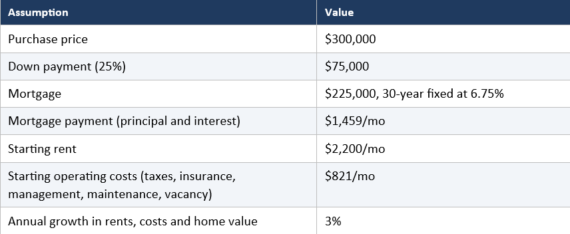
The home does not need to be in the child’s future college town. It should be in a market chosen for long-term rental demand and appreciation, because no one knows at birth where the child will go to school. Closing costs, reserves and income taxes are left out to keep the example clean.
What 18 years builds
By the child’s 18th birthday, the home is worth about $510,700, the loan is down to about $143,700, and equity has grown from $75,000 to about $367,000. Residents’ rent paid for nearly all of it.
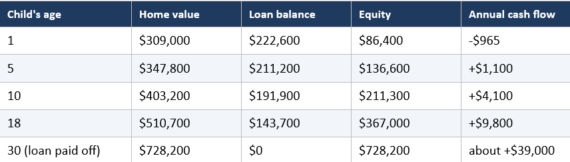
The parents write a small check in the first two years, about $1,400 in total. From year three on, rent growth outpaces the fixed mortgage payment and the home pays its owners. Over 18 years, cumulative cash flow adds roughly $72,000 on top of the equity.
That puts the total at about $439,000 by age 18 from a $75,000 start, before selling costs and taxes. The engine behind it is the same one that drives any leveraged rental: appreciation on the full value of the home, a loan paid down by residents, and rents that rise while the payment stays flat.
Using it in a bigger way
At 18, the home gives the family choices that a college-town condo never could. It can be sold for tuition, borrowed against tax-free, used as an income stream, or held as a launchpad for the child’s adult life.
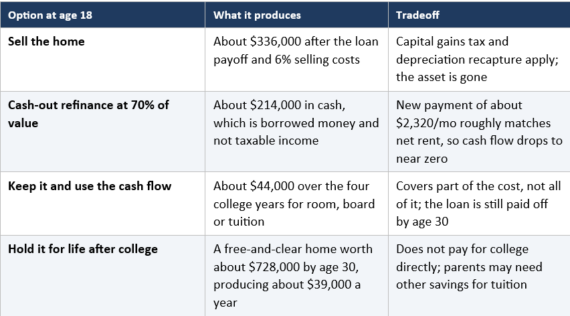
The options can also be combined. A family might refinance to pay tuition, then transfer the home to the child after graduation. The residents then pay off the new loan while the graduate learns to own an investment property.
That last part may be the biggest benefit. A young adult who grows up watching a rental work, and then owns one at 22, starts their financial life years ahead of their peers.
It does not need to be near their school
The home bought at birth almost never ends up in the child’s college town, and it does not need to. Its job is to build equity for 18 years, and that equity can follow the child wherever they enroll.
When the acceptance letter arrives, the family has several paths:
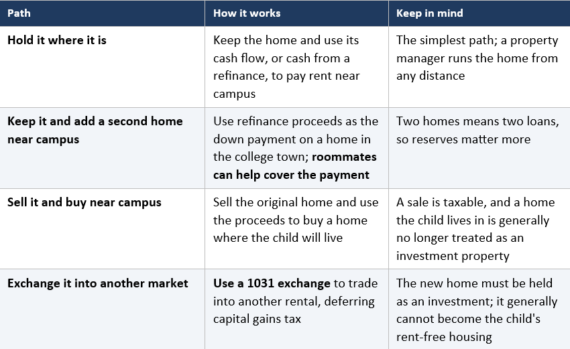
This flexibility is a key advantage over buying near campus at 18. The family chooses the strongest rental market at birth, lets it work for 18 years, and only then decides where the equity should go. A CPA should review any sale or exchange before it happens, because the tax rules on related-party use and 1031 exchanges are specific.
How it compares with a 529 plan
The same $75,000 invested in a 529 plan at birth would grow to about $214,000 at 6% a year or about $254,000 at 7%. The rental builds roughly $439,000, but with leverage, more work and less favorable tax treatment for education.
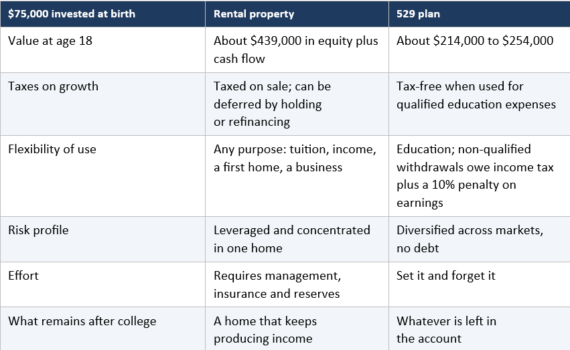
This is not an either-or decision. Many families would be well served by a 529 for core tuition and a rental for everything a 529 cannot do. The rental does its best work as the asset that keeps going after the tuition bills stop.
Risks and fine print
An 18-year runway reduces many of the risks of leverage, but it does not remove them. Families should plan for these before buying.
-
Values can fall. Eighteen years has historically been long enough to ride out most housing downturns, but there is no guarantee. A sale forced at the wrong moment, for tuition or anything else, can turn a paper loss into a real one.
-
Reserves are essential. Vacancies, repairs and resident defaults happen. Holding several months of payments in reserve keeps the plan on track without dipping into family savings.
-
One home is concentrated. A single property depends on one local economy and one resident at a time. Families with more capital can spread the idea across two homes in different markets.
-
Taxes matter at the exit. Depreciation shelters rental income along the way, but selling triggers capital gains tax and depreciation recapture. A CPA should model the sale, refinance and gifting options before the child turns 18.
-
Financial aid treats it differently. Equity in investment real estate is generally reported as a parent asset on the FAFSA, and rental income counts as parent income. A parent-owned 529 is also reported as an asset. Families expecting to qualify for aid should review this with a financial aid advisor.
-
Titling and gifting need a plan. Most families own the home in their own name or an LLC and transfer it later. Gift tax rules, liability protection and estate planning all come into play, so an estate attorney should be involved early.
-
Management should be professional. The strategy only works over 18 years if the home is well run. Professional property management keeps it hands-off for the parents and consistent for residents.
The bottom line
Buying a home when a child leaves for college is a housing decision. Buying one when they are born is a wealth decision. With 18 years of appreciation, rent growth and principal paydown, a $75,000 start can become a $439,000 asset that pays for college, produces income, or gives the child a free-and-clear home by age 30.
The best time to start is the year the child is born. The second best time is now, because every year of runway gives residents more time to pay down the loan and the home more time to grow.
This piece is for educational purposes only and is not financial, tax or legal advice. All figures are hypothetical and simplified, and actual results will vary. Consult a licensed lender, tax professional, financial advisor and estate attorney before making investment decisions.