
By Elyse Sarnecky | Marketplace Homes
Detroit is one of the most underrated real estate investment markets in the country. And if you’ve been paying attention, you already know that the story of Detroit has been quietly rewriting itself for over a decade.
What was once a cautionary tale about urban decline has become one of the most compelling comeback stories in American real estate. Property values are rising. Population is stabilizing. Major employers are investing. And for investors who got in early — or who are getting in now — the returns have been significant.
But Detroit is not a monolith. Like any major city, it’s a collection of distinct neighborhoods, each with its own character, price point, tenant profile, and investment potential. Buying in the right Detroit neighborhood can make all the difference between a property that cash flows from day one and one that sits vacant.
This guide breaks down the best neighborhoods to buy investment property in Detroit right now — whether you’re chasing cash flow, appreciation, or both.
Why Detroit Real Estate Is a Smart Investment in 2026
Before diving into specific neighborhoods, it’s worth understanding why Detroit continues to attract serious real estate investors from across the country.
Affordability. Detroit offers some of the lowest price-to-rent ratios of any major metro in the United States. For investors focused on cash flow, that math is hard to argue with. Properties that would cost significantly more in markets like Atlanta or Phoenix are still accessible in Detroit at price points that make the numbers work. If you’re still building your investment property buy box, Detroit is one of the few major markets where beginners can find properties that meet strict cash flow criteria.
Revitalization momentum. Downtown and Midtown Detroit have undergone a genuine transformation over the past decade. Major employers including General Motors, Quicken Loans, and a growing tech and healthcare sector have brought jobs and residents back to the city. That employment base creates rental demand — the foundation of any strong investment market.
Out-of-state investor friendly. Detroit has a well-established property management infrastructure, making it one of the more accessible out-of-state markets for investors who don’t live in Michigan. With the right team in place, owning a Detroit turnkey rental property from anywhere in the country is not just possible — it’s common.
Neighborhood diversity. Detroit offers something for every investor type — from turnkey single-family rentals in established residential neighborhoods to value-add opportunities in transitional areas with strong appreciation potential. Investors interested in pre-foreclosure properties will also find Detroit particularly fertile ground, as the city continues to have a higher-than-average inventory of distressed properties available below market value.
The Best Detroit Neighborhoods for Real Estate Investors Right Now
1. East English Village
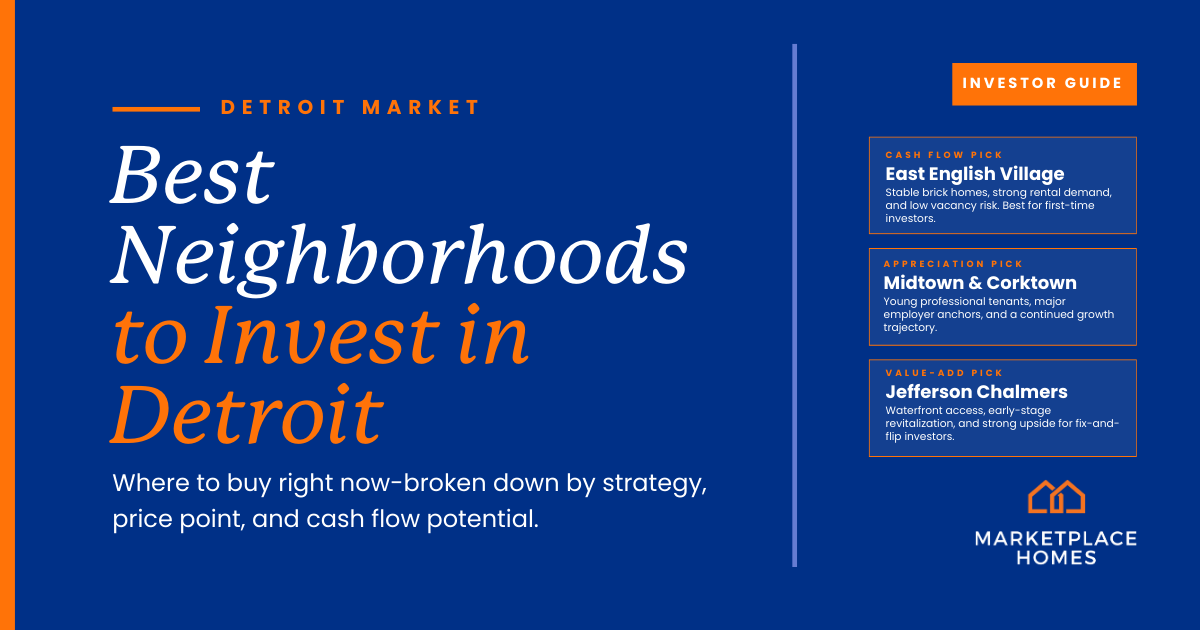
East English Village is consistently one of the most recommended Detroit neighborhoods for first-time investors — and for good reason. It’s one of the most stable residential neighborhoods on the east side of the city, with well-maintained brick homes, active neighborhood associations, and a strong sense of community identity.
For investors, East English Village offers relatively affordable single-family homes with solid rental demand from working professionals and long-term tenants. The neighborhood’s stability means lower vacancy risk — one of the most important factors for cash flow investors. It’s also a neighborhood that has held its value well through Detroit’s ups and downs, making it a lower-risk entry point for investors who are new to the Detroit investment property market.
Best for: First-time investors, cash flow, lower risk, long-term holds
2. Grandmont Rosedale
Grandmont Rosedale is actually a collection of five historic neighborhoods on Detroit’s northwest side, and it’s one of the strongest investment areas in the entire city. The area is known for its beautiful craftsman and colonial-style homes, tree-lined streets, and one of the most active community development organizations in Detroit.
Investor interest in Grandmont Rosedale has grown steadily as the area has attracted a mix of longtime residents and new buyers drawn by the neighborhood’s architectural character and relative affordability. Rental demand here is strong among tenants who want the feel of a well-established neighborhood at a reasonable price point — translating to quality tenants, lower turnover, and steady cash flow for investors.
For investors considering the fix-and-flip strategy, Grandmont Rosedale also presents occasional opportunities to purchase older homes that need updating at favorable price points, with strong resale demand from owner-occupants moving into the neighborhood.
Best for: Cash flow, quality tenants, long-term appreciation, buy-and-hold investors
3. Midtown Detroit
Midtown is Detroit’s most dynamic neighborhood right now and home to some of the city’s most significant revitalization activity. Anchored by Wayne State University, the Detroit Medical Center, and a growing cluster of restaurants, galleries, and tech companies, Midtown attracts young professionals, students, and healthcare workers — all strong rental demographics.
Property values in Midtown have appreciated significantly over the past decade and continue to trend upward. For investors, that means less raw cash flow than the more affordable east side neighborhoods, but stronger appreciation potential and a tenant base that is typically higher income and lower maintenance.
Midtown is also well-positioned for continued growth as Detroit’s downtown economy expands outward. Investors who buy Detroit investment property here today are buying into a neighborhood with strong long-term fundamentals and a tenant pool that shows no signs of shrinking.
Best for: Appreciation, young professional tenants, long-term growth, experienced investors
4. Corktown
Corktown is Detroit’s oldest neighborhood and has become one of its hottest investment markets. The announcement of Ford Motor Company’s massive investment in the Michigan Central Station project transformed Corktown from a hidden gem into a nationally recognized destination neighborhood almost overnight.
For investors, Corktown represents the higher end of the Detroit market — both in terms of price point and potential upside. Properties here have appreciated dramatically over the past several years and continue to attract significant interest from buyers who see the neighborhood’s trajectory as one of the clearest in the city.
Short-term rental potential is also significant in Corktown given the neighborhood’s growing reputation as a destination and the ongoing development activity bringing new businesses and foot traffic. If you’re researching off-market real estate deals in Detroit, Corktown is a neighborhood where off-market opportunities can still be found before they hit public listings.
Best for: Appreciation, higher price point investors, short-term rental potential, long-term upside
5. Jefferson Chalmers
Jefferson Chalmers is a waterfront neighborhood on Detroit’s east side that has been quietly attracting investor attention for several years. Situated along the Detroit River with views of Grosse Pointe and access to recreational waterfront, Jefferson Chalmers offers something genuinely rare in a major Midwest city — affordable waterfront investment properties.
The neighborhood is in an earlier stage of revitalization than some of the areas listed above, which means more risk but also more upside for investors with a longer time horizon and a higher tolerance for value-add opportunities. Renovation projects here can produce strong returns as the neighborhood continues to develop — making it a compelling market for investors with access to a reliable renovation team.
Best for: Value-add, fix-and-flip, long-term appreciation, higher risk tolerance
6. Woodbridge
Woodbridge is a historic neighborhood just west of Midtown that has been steadily attracting young professionals and creative types priced out of Midtown proper. The neighborhood features beautiful Victorian-era homes, proximity to Wayne State University, and a growing arts and culture scene.
For investors, Woodbridge offers an interesting opportunity — a neighborhood with strong bones, increasing rental demand, and price points that still represent real value compared to Midtown. It’s the kind of neighborhood where investors who buy Detroit investment property now are likely to look very smart in five years.
Renovation opportunities abound here for fix-and-flip investors, and the tenant demographic skews toward young professionals and graduate students who value the neighborhood’s character and walkability. Investors who want to know how to buy an off-market property will find Woodbridge one of the more active off-market neighborhoods in the city.
Best for: Value-add, appreciation, young professional tenants, fix-and-flip
How to Choose the Right Detroit Neighborhood for Your Investment Goals
With so many compelling options, the right Detroit neighborhood comes down to your investment strategy and goals.
If you’re a cash flow investor prioritizing immediate monthly income with lower risk, East English Village and Grandmont Rosedale are your best starting points. The price points are accessible, the tenant base is stable, and the vacancy risk is lower than more transitional areas.
If you’re an appreciation investor with a longer time horizon, Midtown and Corktown offer the strongest growth fundamentals — though you’ll pay more to get in and accept thinner initial cash flow in exchange for upside.
If you’re a value-add or fix-and-flip investor, Jefferson Chalmers and Woodbridge are worth serious attention. Both offer renovation opportunities in neighborhoods with genuine long-term potential at price points that still make the numbers work.
And if you’re an out-of-state investor new to Detroit, working with a team that has on-the-ground experience in the market is essential. Detroit’s neighborhoods can change significantly block by block, and local expertise matters more here than in more homogeneous markets.
📥 New to real estate investing?
Download our free First-Time Real Estate Investor’s Guide — including a market evaluation checklist you can use to assess Detroit and any other market you’re considering.
Marketplace Homes and the Detroit Investment Property Market
Marketplace Homes has been working with real estate investors in the Detroit market for years. Our team has deep knowledge of the neighborhoods outlined in this guide — where the deals are, which Detroit neighborhoods are appreciating fastest, and how to find quality tenants in each part of the city.
Whether you’re looking for a turnkey rental in East English Village, a fix-and-flip opportunity in Jefferson Chalmers, or a long-term appreciation play in Corktown, we can help you find the right Detroit investment property and manage it after closing.
We also work with investors interested in the broader Detroit metro — including suburban markets like Dearborn, Warren, and Sterling Heights that offer strong fundamentals alongside the city itself.
If Detroit real estate investing is on your radar, we’d love to talk through the market and help you identify the right opportunity for your goals.
"*" indicates required fields
"*" indicates required fields
And don’t forget to grab our free First-Time Real Estate Investor’s Guide if you’re still in the early stages of building your investment strategy.